
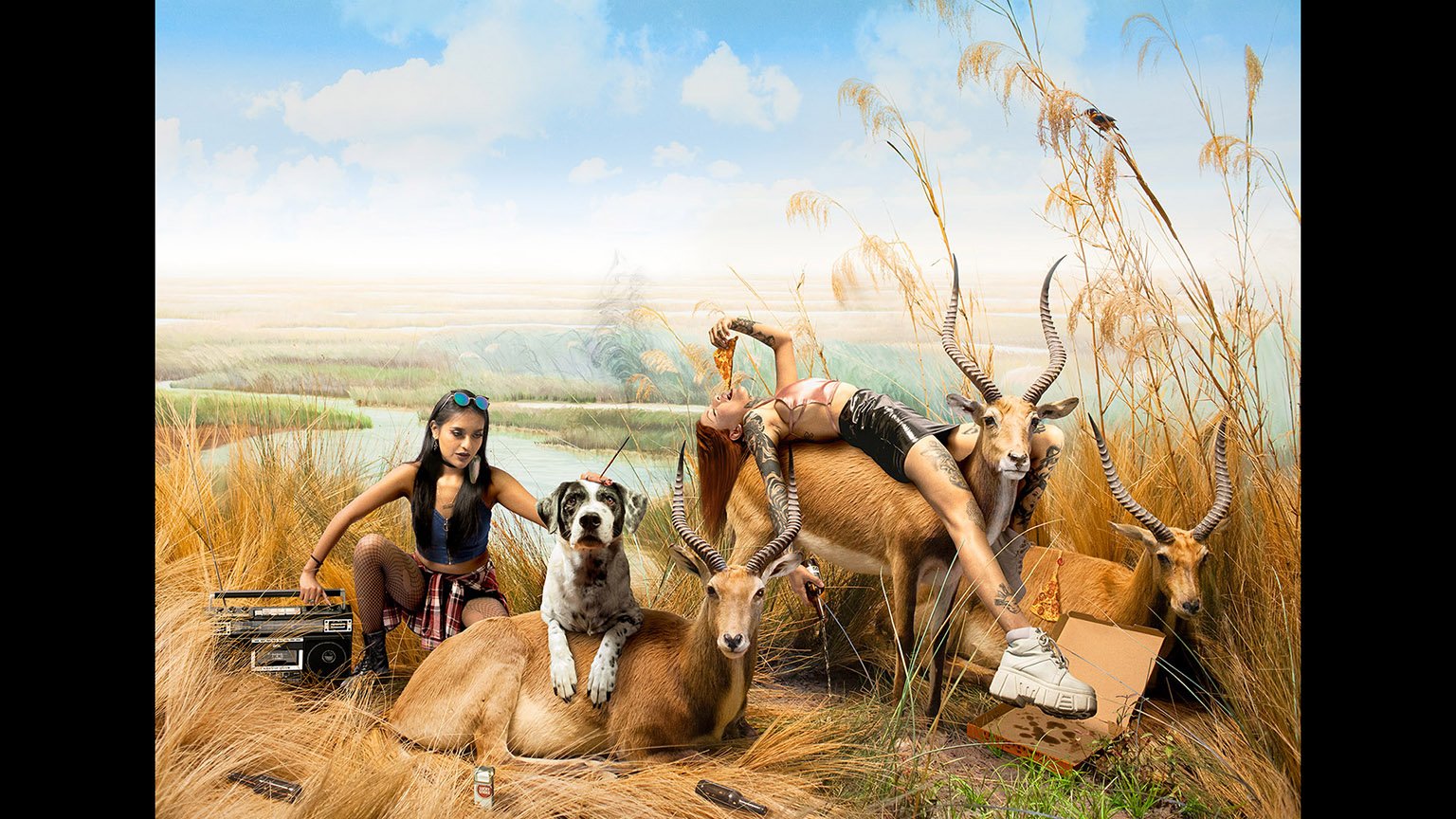
When I met my current partner here in Mexico City, she joked about how much of a bad influence she was on me. Something just clicked. Suddenly I had this rush of ideas.
Rob: To start off, tell me where you're from. What does your photographic life look like?
Nick Schwartz: My name's Nick Schwartz. I'm a photographer based on both sides of the Gulf of Mexico—Mexico City and Orlando, Florida. I've been in the industry for between 15 and 20 years, under various roles from assistant all the way to photo producer and a little bit of art direction.
Rob: How did you end up in Mexico City?
Nick: COVID happened. I used to live in California, the Bay Area. I decided to leave because it's expensive there. For a while, I traveled all over the West Coast, being a digital nomad. Then I was going to make my next trip to go all over Latin America. My first stop was Mexico City, and I loved it so much I stayed. It also helped that I met my current girlfriend here.
Rob: How much do you work back in Orlando versus Mexico City?
Nick: Right now, it's about two-thirds Mexico City.
Rob: Before we get into your specific project Bad Influence, what do you consider to be your strengths as a photographer?
Nick: When I first started photography, I shot a lot of family portraits and headshot work. Nowadays, I shoot more conceptual, creative portraiture. I moved in this direction because I find it a lot easier to shoot stuff that I conceive in my head than finding things to shoot like a documentary or lifestyle photographer would.
I have so many ideas in my head that I've planned out that I'll never shoot.
Rob: Why?
Nick: Just time.
Rob: Do you write them down?
Nick: Yeah, I have a big Word document just full of ideas.
 Rob: Tell me about Bad Influence. Where did this idea come from, and how did you get started?
Nick: Originally, I had some museum backplates from another project. They were shot at the Academy of Sciences in San Francisco. It was for a project a long time ago that fell through, but I held on to the backplates.
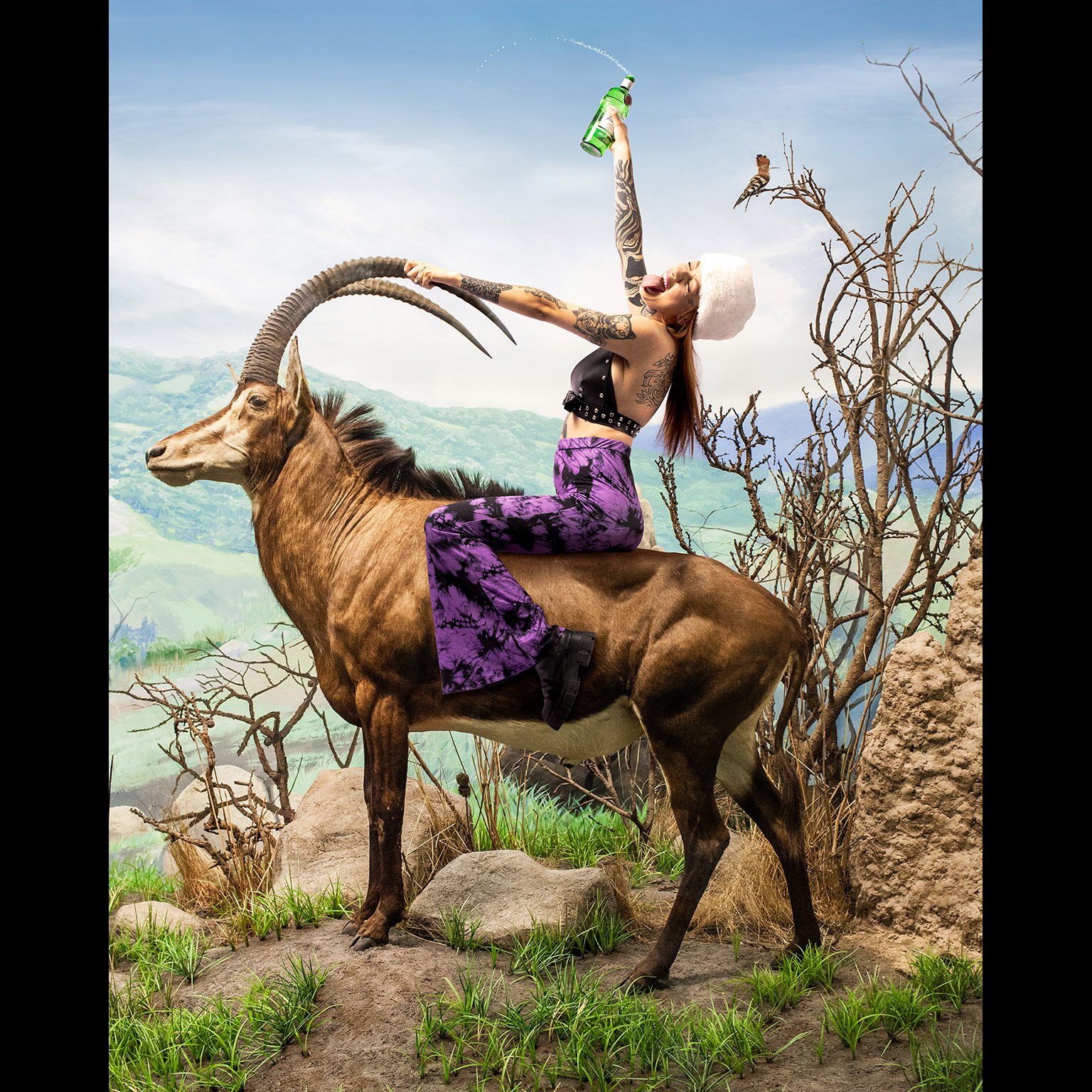
When I met my current partner here in Mexico City, she joked about how much of a bad influence she was on me. Something just clicked. Suddenly I had this rush of ideas. I started thinking about how I could represent that "bad influence" idea.
At first, I thought about creating images that imitated the natural history museum diorama look, but with punkish, rebellious, sexually deviant women in human habitats behind glass. Then I remembered I had these backplates stored from a long time ago, and I felt that using animals would make the images even funner.
Rob: Tell me the process. You're looking at a backplate with certain characteristics. What happens next?
Nick: The hard part is finding dioramas or backplates that resemble the idea I have in my head. When I go to a museum, I take pictures of every single diorama. Then I go through each one and think about what I could represent in this image, what the animals are doing.
 Nick: Take the one where there's a couple of antelopes and a woman in her underwear going down to a coke tray. Right away when I looked at that one, I got the idea. What are they looking down at? Underwear isn't exciting enough. Maybe some alcohol? Oh, a coke tray.
For some images, something just clicks right away. For others, I have to sketch out various ideas—I'll bring it into Photoshop and sketch out a few concepts.
 Rob: There are also ones where there's a direct interaction with the animal, like the woman sitting on the ram. How do you execute those ideas?
Nick: A lot of my work is composite work. It's not like I'm bringing models into museums and photographing them, messing up their dioramas. I knew this series would have to be a lot of composite work.
I always begin my pre-production by sketching out my ideas. Then I analyze the backplates—the lighting, the environment—and I bring the models into the studio and try to imitate that the best I can.
I kind of treat my models during these shoots like they're still lives. I'm moving them in minute ways just so they match up correctly. I don't know how much the models enjoy that, but so far, no complaints.
 Rob: What's your process for matching the light?
Nick: Most of the time when I'm doing composites like this, I'll write on my phone the angle of the light and all that. Then in the studio, it's trial and error—playing around with gels.
Rob: I feel like you're underselling how difficult that is.
Nick: It's a little bit of thought, but honestly, I just think "the light's over here, so I'll put the light over there."
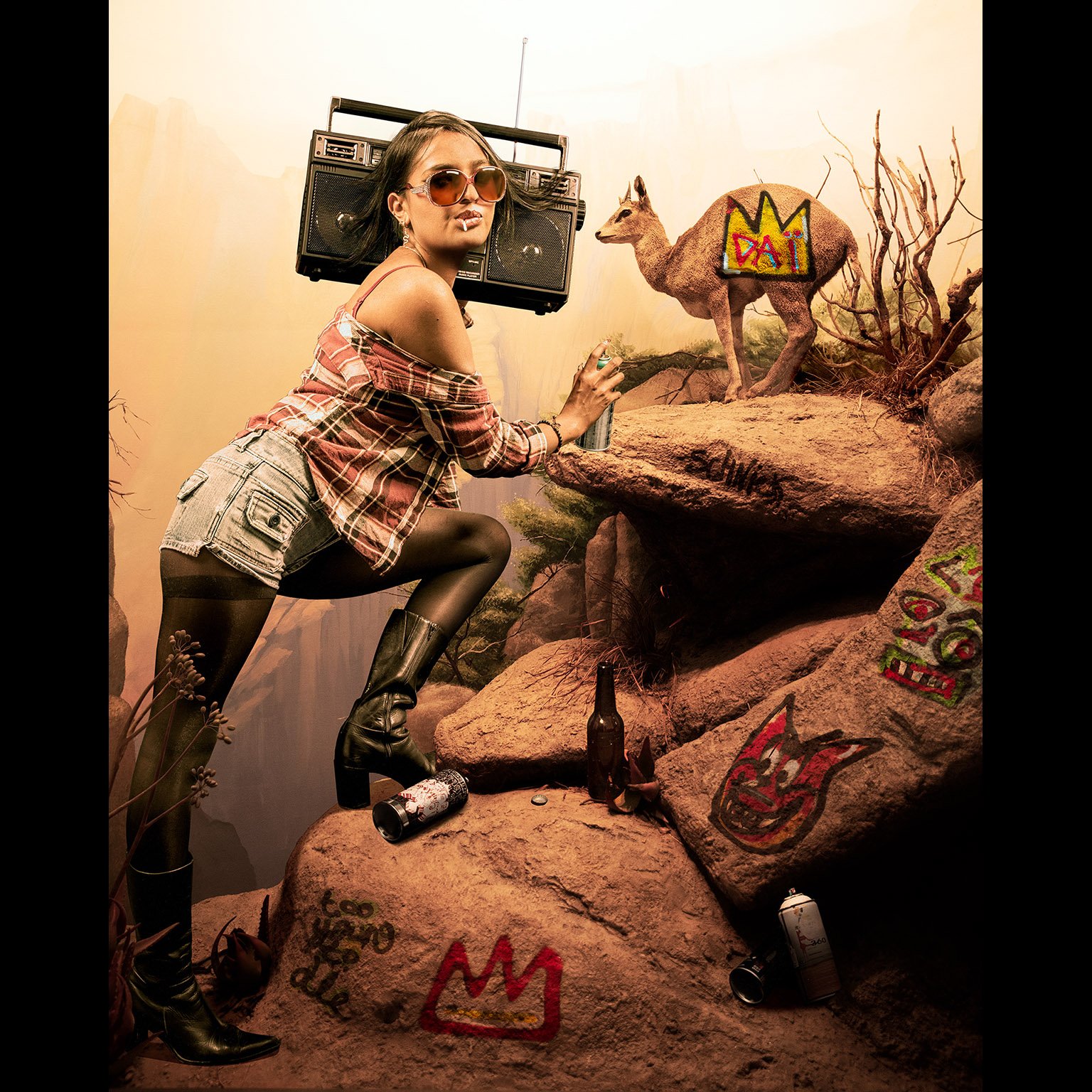
 Rob: But you've managed to capture not just the direction but the quality. In the one with the wolf, the quality of the light on the wolf and the quality of the light on the woman—it feels like sunrise.
Nick: I gotta give props to the museums for their lighting.
Rob: Do you have a favorite picture from the series?
Nick: I really love the one with the wolf—that's the newest one I added. It's just fun. I think it feels very much like you're spying on them on this mountaintop, and they're just being bad.
Rob: Tell me about the response you've gotten from this work.
Nick: Throughout my whole portfolio, these have gotten the most positive responses. I've gotten a few jobs from this series—a couple photography jobs and a couple retouching jobs. People are loving it.
I actually just recently shared them at an art gallery, a pop-up art gallery here in Mexico City. Have you ever heard of Pancakes and Booze?
Rob: No, but it sounds fun.
Nick: They go all over the US too. I just decided to contribute, and people loved them.
Rob: How large did you print them?
Nick: About poster size.
Rob: I feel like I want to see them large because they reward continued viewing. They’re definitely better on a monitor than a phone.
Nick: Those are the thing I like to shoot—images where your eyes are moving around and you're looking at different things.
I think it goes back to the old Renaissance paintings where they composed their paintings so your eyes are forced to move around. And maybe it even comes from when I was a little kid, looking at Where's Waldo. I've just always enjoyed images like that.
 Rob: Have the museums seen the work?
Nick: They haven't. Most of these, the older ones, are from the Academy of Sciences in San Francisco. The new ones with the clown chick are from the Natural History Museum here in Mexico City. This is a series I want to keep going. Each time I visit a new museum somewhere, I'm gonna keep adding to it.
Rob: How does your commercial process compare to this process?
Nick: With Bad Influence, I'm pretty much working on my own. With commercial projects, you're working with a whole team, so there's a lot of give and take. Communication is critical to the creative process. You have to hear and bounce ideas off the whole creative team. With every assignment, I prefer to work as close with everyone involved as possible.
 Rob: What about the size of the work? Human-scale dioramas versus tabletop and work that fits in your hand?
Nick: To me, they're kind of the same because, like I said, I treat my models like they're still lives. It's just kind of a bigger still life. Actually, the reason I realized that is because my still life professor in college pointed it out to me. He said, "I see that you keep treating your models as still lives. If you want to use models in your still life class, you could do it." So I just rolled with it.
Rob: Thanks so much for talking to me. Where can people find you, Bad Influence, and the rest of your work?
Nick:
schnickphoto.com
instagram.com/schnickphoto
linkedin.com/in/schnickphoto/
Tags
Comments (0)
No comments yet.
Sign in to join the conversation.