

Rob Culpepper: First off, tell me who you are, where you're from, and what kind of work you do.
Doug Levy: I’m Doug Levy. I grew up about half an hour south of Boston. Now I live about forty minutes northwest of Boston. I've been a professional photographer since 2009, which is when I quit umpiring professional baseball—my previous job. I did that for six years after college.
When I started photography, any job was better than having to get a regular job. So I shot a lot of high school sports. It was my off-season job for the last two years of baseball: photographing for local newspapers, families, babies, anything and everything.
I was reading a lot. That was the good thing about baseball, we had a lot of downtime. So I was reading maybe fifty blogs a day on everything photography: post-production, photo critique forums, business. And then—the shorter version of this story is—I got hit in the head with a bat without my helmet on, and decided I didn't really want to umpire anymore.
Fast forward to the end of the 2009 season and I started doing mostly weddings - I was 28, and at that age where it was very easy to bond with couples. The barrier to entry was very low. You didn't have the more complicated lead time and sales process you have with commercial work. You could wake up with nothing booked and book three weddings in a day, just because somebody you went to high school with recommended you.
 Rob: What made you switch from weddings to commercial work?
Doug: Looking back on it, I think I did weddings because I enjoyed the wedding day and the challenges of it. To be a good wedding photographer, you have to be good at portraits, event coverage, and lighting; figuring things out when it's sunny and then starts raining; and making good photos in bad locations. I enjoyed that. In a lot of ways, I’m still doing that today. We don’t always have time for a location scout, every assignment isn’t in a beautiful spot, but that’s the job, you make it work.
There was overlap with umpiring, too. In baseball, you get one chance to get that pitch right. You get one chance to get somebody's wedding right, or they're going to hate you forever. There was a rush there, especially at the beginning, where with weddings one through ten, there's a massive jump in quality. But after about wedding fifty, I knew my clients would be happy, and I was trying to make photos that were 1% or 2% better.
Toward the end, I was lugging medium format gear and studio lights to weddings just trying to find something to challenge myself and to make photos I found interesting, compelling.
Looking back, my brain was always more portrait-oriented. Even at the beginning, I was doing some editorial work, mostly for the newspaper that I had shot sports for. I freelanced for $75 assignments that I would pretend were the cover of Vanity Fair.
My heart was always in editorial, advertising, and larger productions, in spending all day to make five or ten great photos. If you make ten great photos at a wedding and say "Here you go," they're like, “Where are the rest?"
Rob: I resonate so much with your journey through weddings. I worked for a wedding photographer early in my career. He shot super high-end weddings in really cool places, at great venues, with amazing bands. Once you go to a bunch of them, you realize you've actually been to this venue five times and the band is playing the same set.
Doug: I would have to psych myself up on the drive to the last twenty-five weddings and be like, this is really important for them. Just because you've done five hundred of these doesn't mean it's not important for them.
 Rob: Let’s talk about your two projects. Give me a little bit of backstory of the hot sauce one.
Doug: It started the year before, when I referred a job to a wedding photographer friend of mine and, as a thank-you, he signed me up for a Hot Sauce of the Month Club. We've always been hot sauce fans, but three hot sauces coming every month is a lot. We'd done about 18 months of this and realized we had maybe 75 or 80 bottles. And the designs on the bottles is amazing, like craft beer. Really wild stuff.
I wanted to try them all, but I also didn't want to just open them and let them sit in the fridge. So I thought: what if we throw an open house party and have people come over and just taste these?
The brief was: I invited everybody we knew. They had to sign a model release and wear a white t-shirt, because I wanted some coherence between the photos.
We moved all the furniture out of my living room and set up a little studio with the coffee table.
I went out and found the absolute hottest thing on the market, which was actually not a sauce. It was an extract. As hot as bear spray, basically. It was made to put one eyedropper amount into a pot of chili for sixty people. The warning label said “Do not consume raw, do not touch your eyes, do not go to the bathroom after handling this.” You read that and think, “Yeah, whatever, it's marketing.”
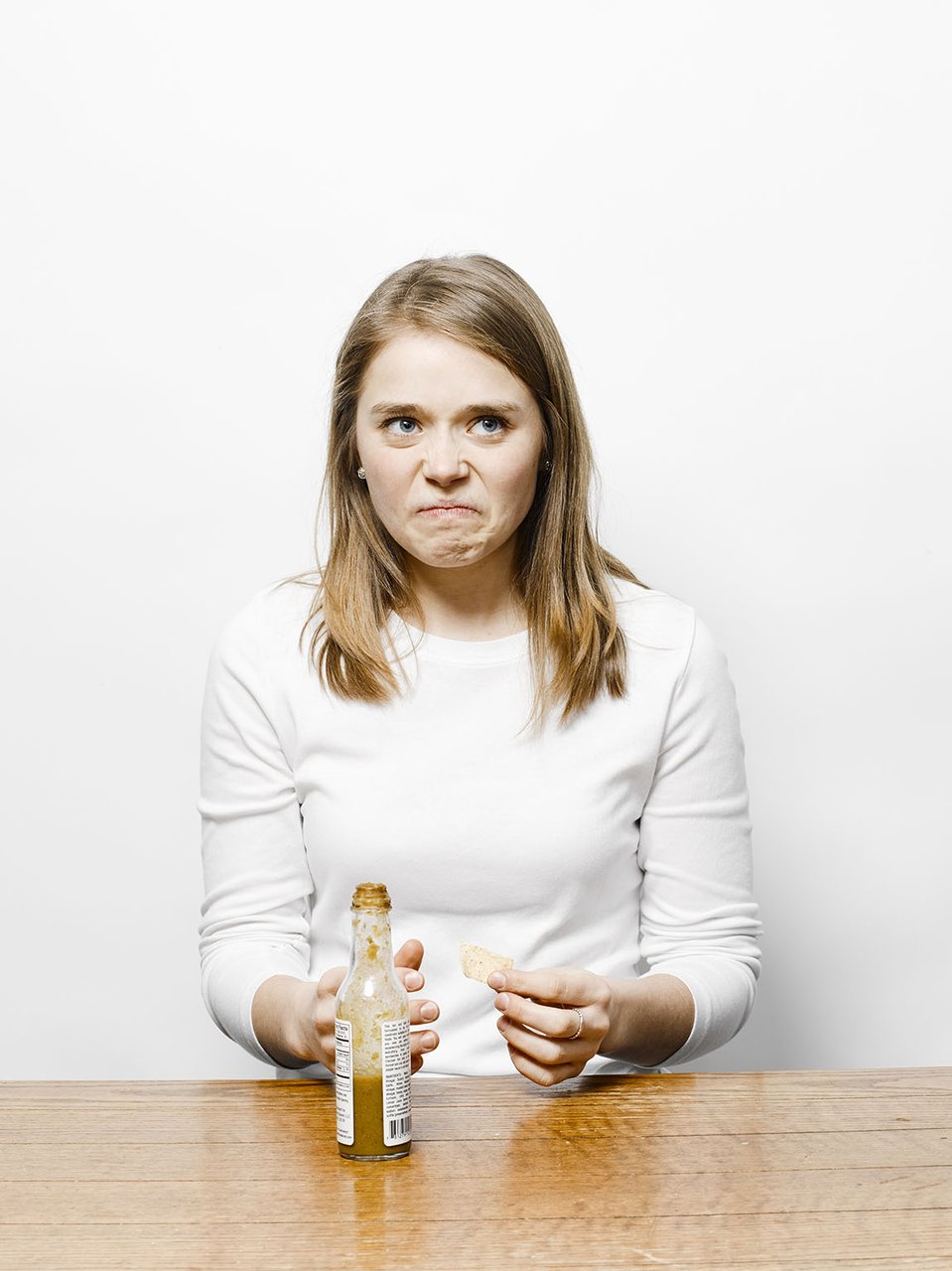
 Doug: So the idea was: everybody gets to try one sauce of their choosing. And then they have to try the extract raw on a Triscuit or Tostito. We had food and beer, and we had milk, because milk helps if something's really hot. For the extract, it became very obvious that milk wasn't getting the job done after the first four or five people suffered.
My dad went out and got two dozen Hoodsie cups—the little half-chocolate, half-vanilla ice cream cups with the wooden spoon. The ice cream coats your mouth and everything on the way down. Much better relief.
It ran from 9 to 9. Friends were bringing friends. One of my assistants came early and tried the extract. I was still shooting people at 6:30, and he texted me, "I'm at the ER." I was like, you are so full of it. He sent me a picture. I was like, “Oh my god, you're actually at the hospital!” He said the nurses were laughing at him.
 Rob: I really like the way it's executed. You see the hot sauce a little bit, but it's really about the person and the expression.
Doug: That was the goal. The white t-shirt was about eliminating everything else but the person. I tested shooting just head and shoulders, but it became clear that the reaction was full body. They don't know what to do with their hands, they're touching their eyes, their whole face is going. I probably would have shot full length if I’d had enough room in my house.
It almost became like a photo booth.
 Rob: Let's switch over and talk about the craftsman pictures. How did this project start? How did you find these subjects?
Doug: It was 2011 or 2012. I knew this guy who worked for a nonprofit called Mass Farmers Markets. They worked with all these local farms and ran a farmers market on weekends in downtown Boston. He decided to have a cocktail event using all garnishes and fruit from local farms. I said, “What if we go do portraits of all the farmers to help promote the event?”
Later it turned into portraits of all the bartenders. They got the best bartenders in Boston, and I went and did portraits of all of them making cocktails.
I didn't know going in, but there was a a Boston-based whiskey company that was the alcohol sponsor for the event. They were pretty small at the time. Two brothers, called Bully Boy Whiskey. I went and photographed them just because I thought it would be a cool picture.
 Doug: Then I thought, “Oh, maybe there's more to this." The next one was a blacksmith. In New England, because of the colonial roots, there are a lot of old wrought iron gates, latches, hinges, and all those sorts of things on old houses. He had this business where you'd bring him your broken colonial iron hardware and he'd repair or recreate it to look original. From there it was, “Well, what else is there?”
I'm also somebody who has no ability to fix or make anything. I can change a flat tire, check my oil, wash my car, mow the lawn, and that's about it. So it became: what if there's a whole series of people who have these skills that I don’t? At the beginning it was easy, because anyone building or making things by hand was fair game.
 Doug: I’d get leads two ways. Sometimes I had an idea, like the guy who fixes and customizes shotguns.The other way was through the subjects themselves. They all know each other. These are all tiny businesses, sometimes not tiny by revenue but tiny by headcount. It’s often just them, or them and a partner. I always end my shoots with: who do you know? Who should I shoot next?
Now it's much harder because I've done all the obvious stuff. I'm trying to find what I haven't done already, or something interesting enough to revisit.
One of my favorite photos is from a guy who was repairing old planes from the Korean War era. I had a client—a private jet company—and when enough regular clients see your personal work, they go, "You should meet this person." This guy was a retired pilot who ran an aviation museum and fixed old planes in his spare time. He was half an hour from me, so I went up and spent a morning with him. He explained an engine to me and I had no idea what he was talking about, but: cool photos. He offered to take me up in a plane at the end, but this was one of those open air planes from the Korean War - I was like, “Thanks, I’m good.”
 Rob: When you get to a location, what's the first thing you do? How do you start thinking about what you want the picture to be?
Doug: Once in a while, especially if it's outdoors, it starts with a Google Maps search—what does the area look like? But most of these are inside. Even before we unpack the car, I want a tour of the whole space. Where are your outlets? Can I turn the lights on and off? Can I close the blinds? Do you have loud neighbors?
And then when we get to shooting, a lot of times the direction to the subject is: I need you to do what you would normally do, but at half speed.
My approach is: I close windows and turn off overheads, and I add light to show you what I want you to see. With this series especially, the focus is on their hands, their work product. I want to direct your eye. I don't need the whole frame over-lit in a way that's distracting. One or two lights is almost always enough. Most of these are strobe-lit.
Rob: One of the things that strikes me is the consistency across the series, even though you've been doing it for almost 15 years. How have you maintained that look and tonality over time?
Doug: My personal taste hasn't changed a ton. I think that's probably the biggest part of it. My skills have changed and my equipment has changed, but what I like hasn't. Blue is still my favorite color, it has been since I was five. I like neutral skin tones, slight blue tones in the shadows, deep blue skies. I'm not chasing trends because unless you're setting the trend, you're always behind.
Consistency also translates to paying client work. If you hire me and trust me with your marketing money, you know what you're going to get.
A lot of my growth is in efficiency, not in changing the look. I know what a "Doug photo" looks like, so now instead of taking five hundred frames to get what I want, I might take fifty. I've also gotten better with people. I know when my subject is emotionally done, and I know when to stop.
 Rob: What's exciting to you about photography right now?
Doug: There are two buckets. I love the business side just as much as—if not more than—the creative side. I love owning a business, finding unique solutions, fixing things. It's stressful, but it's fun.
Creatively, the thing I'm most excited about right now: I have a job at the end of the month where I'm going to photograph at four baseball games. My whole life, I did a thousand professional baseball games as an umpire, but I've never really photographed baseball. And I get to bring my seven-year-old. He's going to have a camera. In a Field of Dreams kind of way, that's going to be incredibly fulfilling.
But the best thing, and this hasn't changed—this is really the heart of the Craftsman series—is that you have this license as a photographer to approach anything that looks cool or interesting and say, “Can I take your picture?”
See more of Doug's work
https://www.douglaslevy.com
https://daybreakdirectory.com/photographers/doug-levy
Comments (0)
No comments yet.
Sign in to join the conversation.